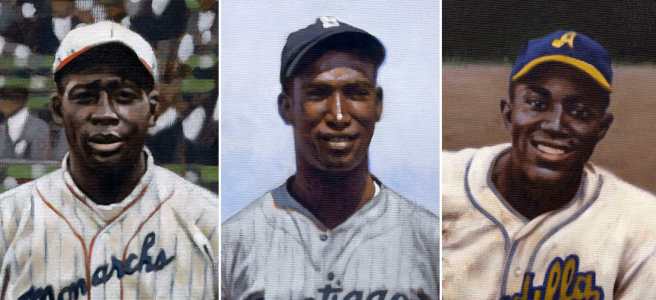
In part one, we looked at how NL teams that were quick to embrace integration kicked the crap out of teams that were reluctant to integrate for decades.
Now we’re going to look at individual players’ performance. Let’s look at how the players who would not have been allowed to play in the National League prior to 1947 performed compared to their pale counterparts once they were granted admission to the NL.
(Side note: To be clear, we’re not just talking about African Americans – we’re also talking about players from Cuba, the Dominican Republic, Puerto Rico, Panama, etc., who wouldn’t have been allowed in the NL prior to 1947.)
In 1948, Stan Musial won his third MVP award and led the NL in WAR for the fourth time in his career. It would be the last time he’d do either of those things despite averaging 7.2 WAR over the next nine seasons. I’m sure you know why that is, but for funsies, let’s look back anyway…
Starting in 1949, when there were still only a few non-white players in the league, Jackie Robinson led the NL in WAR and won the Most Valuable Player award. From that point on, players who would not have been allowed in the NL prior to ’47 won 16 of the next 21 NL MVP awards. If you want to start from ’53 on, when most teams were integrated, Black and Latino players won 14 of 17 MVP awards from ’53 to ’69.
Of course, “MVP” doesn’t necessarily mean “best player” in the eyes of many, so let’s look at WAR, which is a good indication of overall on field contributions to one’s team.
Jackie Robinson led the NL in WAR in 1949.From then on, the NL season WAR leader was a Black or Latino player 18 times over the next 21 seasons. If you’re curious about the math, that’s 86% of the time that the league’s best player came from a group that made up a very small percentage of the league.
If you’re thinking that number is disproportionally affected by a small sub-group of a sub-group of players led by Jackie then Willie Mays, I’ll bite…
Over the 21 seasons from 1949 to 1969 Black and/or Latino players placed in the single season top ten in WAR 101 times. To be clear, out of 210 players – the best ten players in 21 different seasons – almost half of them came from a group that was a very small minority of NL rosters.
If you want to start in 1956 when most – “most” not “all” – teams were integrated, over the next 14 seasons, the top ten players in WAR (140 players) 86 of them – almost two-thirds – were Black or Latino.
Therefore, if you think that it was just the Jackie’s, Mays’ and Aaron’s of the world who were dominating the National League for two decades, you’re wrong. Jim Gilliam, Willie Davis, Felipe Alou, Jim Wynn and Jim Ray Hart – among many, many other players who are not considered all-time greats – were also sending a clear message to everyone whose eyes and ears were open.
Other matters to consider:
- Monte Irvin didn’t play a full season in the NL until he was 32 years old. Had he played for the Giants starting at age 21, the numbers would have swayed even further away from the melanin challenged.
- As we mentioned, the AL was a different animal, but let’s not forget that Minnie Minoso and Larry Doby were two of the best five players in the AL from the late 40’s through the 50’s.
- We only discussed position players, as pitchers are also a different discussion here, but let’s not forget that Don Newcombe was a Rookie of the Year, a Cy Young award winner and an NL MVP. And we don’t really need to discuss Bob Gibson and Juan Marichal, do we?
Final thought: If your position is that “sure Black and Latino players were as good as Caucasian players prior to 1947, but because we don’t know about the level of competition, the statistics shouldn’t be combined”, I have bad news for you.
First, Blacks and Latinos weren’t “as good as”, Caucasians, they were/are better (did you see the above numbers?), but more importantly…
The Federal League, the American Association, the Player’s League, the Union Association and the National Association are all included under the umbrella of MLB statistics. Heck, the National League and American League coexisted for just short of 100 years before competing against each other. So, if you’re OK with Cap Anson’s stats being lumped in with Aaron Judge’s, Mookie Betts’ and Juan Soto’s, among many others, I urge you to spend more time on some serious self-reflection – and at the library.
If your position is “Yes, from 1947 on, the best Black and Latino players were clearly better than their Caucasian counterparts (as they were in every sport in which there has been equal opportunity) but I’m just not sure that was the case prior to that in baseball – we’ll just never know”…
You lost.
Did I miss something? Let me know. Leave a comment below or yell at me @mybaseballpage1 on Twitter and/or the “My Baseball Page” on Facebook.
PS: “The Bona Fide Legend of Cool Papa Bell” by Lonnie Wheeler, “The Power and the Darkness” about Josh Gibson by Mark Ribowsky and “Wilber ‘Bullet’ Rogan and the Kansas City Monarchs” by Phil Dixon are good places to start if you want to know about NeL players who never got a shot in the AL or NL.

Buy me a coffee?
If you like the blog and would like to see more of it, feel free to buy me a coffee. I prefer the bougee stuff, but I’ll take a Wawa if you’re buying. (Shrugs.) It may not seem like much, but every little bit goes a long way toward keeping the blog rolling. Thanks in advance!
$1.98
 mybaseballpage.com
Hi. How are you? I really like your blog posts. Please keep reading mine too!
LikeLike