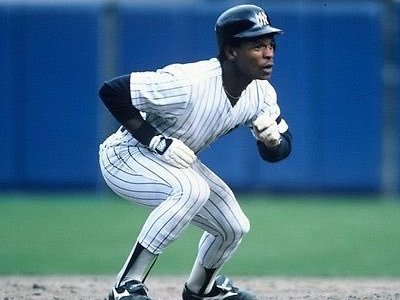
At some point today, raise a glass to remember a dark day in Yankees history and toast those who sacrificed and endured (that would be Yankees fans north of age 45 or so). 35 years ago today, the Yankees traded Rickey Henderson.
If you’re wondering if there was some mitigating circumstances, or if it was a team with a bad record simply thinking long term, not it was not those things. It was just simple stupidity on the Yankees part. Stupidity along the likes not to be seen until the Red Sox would trade Mookie Betts three decades later.
I’m sure you’re aware of some of this, but just to review:
From his age 21 through 25 seasons (four full and one strike shortened), Rickey posted an OBP north of .400, with an OPS+ of 138. He appeared in four All-Star games, had three top ten MVP finishes, won a Silver Slugger and Gold Glove award. He averaged 7.0 bWAR per season (remember, 1981 was shortened so he “only” posted 6.7 in 108 games. I’ll pause while you re-read that) which was the second most in the AL over that stretch and led the AL in runs scored over that stretch as well. Unsurprising, considering he added 460 stolen bases to the .408 OBP.
The Yankees then acquired the 26-year-old monster in December of 1984 for five prospects.
From 1985-1988 in the Bronx, Rickey would average 6.8 bWAR per season (despite missing more than one third of 1987 with injuries) which was second most in MLB over that span. He received four more All-Star nods, won another Silver Slugger award and led MLB in both runs, and runs from baserunning. Again, a four season stretch with a 137 OPS+ and an absurd 301 stolen bases with an 86% success rate, will do that.
Then in 1989, Rickey started off slowly. By slowly, I mean 3.6 bWAR after 69 team games – that’s 8.5 over 162 games if you’re interested. The Yankees stood seven games out of first place in the AL East with 93 games to go and were tied in the loss column with the team that would eventually win the division in ’89 – but they decided to throw in the towel.
One of the best players to ever walk the earth, in his prime, was then traded to Oakland for Greg Cadaret, Eric Plunk, and Luis Polonia.
Plunk would throw 260 league average innings for the Yankees before being released in 1991.
Cadaret wouldn’t be quite as good as “average” and would be released or allowed to leave via free agency 12 times over the last seven years of his career.
Polonia? Well, when he arrived then Yankees hitting coach, the late great Frank Howard, declared that Polonia was a good enough hitter to win a batting title. As it turned out, Polonia earned more prison sentences in his career than batting titles.
You know what happened to Rickey. He went on to lead the league in bWAR in 1989, then again in 1990 with Oakland when he also won the MVP award and a World Series ring*. In fact, he’d go on to post another 49.7 bWAR in his career after the Yankees traded him, finishing his career with 111.1 for his career – a number exceeded post integration only by players named Bonds, Mays, Aaron, and Rodriguez.
(*The Yankees would be 68 games under .500 over the next four seasons.)
You might be thinking the Rickey was an impending free agent and that may have been a factor in the decision to trade him. You would be wrong.
First off, as I’ve written about previously, there was no such thing as “big market/small market” at the time (Bud Selig would invent that fallacy a couple of years later), and therefore no fire sales – and even if there were, we’re talking about the Yankees. Secondly, as mentioned, the Yankees were not out of contention with a lot of season left to play.
No, the Yankees – specifically George Steinbrenner – were just plain dumb. George had already cost the Yankees a shot at another dynasty in the 80’s when he colluded with the other owners to avoid signing free agents (I wrote about that here) but he didn’t learn any lessons obviously, and although we didn’t know it at the time, but the Dave Winfield/Howie Spira saga was coming to a head as well, so George had no patience with any of his well-paid star players as a result.
Add all that up and combine it with – get ready for this – Rickey had a reputation among many Yankees fans and media as a player who “turned it on and off” and was prone to bouts of apparent disinterest. Rickey was a style showman, not a “scrappy, hustle, hustle, hustle get your uniform dirty” showman like teammate Steve Sax – so Rickey had to go.
Of course, we know that Rickey played until age 43, long after making enough money for himself and his grandkids forever. I’m thinking that it’s more likely, given his style of play, that there were stretches in which Rickey was just plain banged up, and it wasn’t laziness or disinterest you were seeing when he didn’t make ostentatious displays of hustle.
As I said, George was just damn dumb.
So for the kids out there who weren’t around to witness this debacle, raise a glass today for your Yankee fan predecessors. You now understand why when jokes about the Red Sox trading Mookie Betts come up we cringe a little instead of laugh – we’ve been there.
(PS: Have you read Howard Bryant’s book “Rickey: The Life and Legend of an American Original”? Let me know.)
Did I miss anything? Let me know. Leave a comment below or yell at me @mybaseballpage1 on Twitter and/or the “My Baseball Page” on Facebook.

Buy me a coffee?
If you like the blog and would like to see more of it, feel free to buy me a coffee – I prefer the bougee stuff, but I’ll take a Wawa if you’re buying. (Shrugs.) It may not seem like much, but every little bit goes a long way toward keeping the blog rolling – thanks in advance!
$1.98
 mybaseballpage.com